

Shipping to 30+ countries

Shipping

Hoptimaal offers a wide variety of beers both in-store and online. If you can place an order, we usually have the product in stock (though mistakes can happen, unfortunately). Products that are in stock will be shipped the same day if ordered before 3:00 PM.

If we make an error with stock levels, you will be notified within 24 hours. In that email, we will offer you an alternative product, the right to a full refund, and a new delivery time. It's up to you how you'd like us to resolve the issue.

We ship all orders with DPD from the Netherlands. You can choose between:

  • Home delivery or delivery to your work
  • Delivery to a DPD pickup point near you

Shipping costs and the free-shipping threshold for your country are in the table below.

Deposit

On cans and bottles we charge the Dutch deposit (statiegeld): €0.15 per can and €0.10 per bottle (a little more for some bottles). It shows as a separate line in your cart. The deposit belongs to the Dutch deposit system: you can return the packaging in the Netherlands, not in deposit machines in other countries.

Shipping Costs by Country

Scroll to the right on mobile ->

CountryShipping costReduced rateFree shipping from
Netherlandspickup point €6.95
home €8.50
–€85
Belgium€8.95–€100
Germany€13.50–€100
Denmark€15.95–€150
Austria€15.95–€150
Bulgaria€47.50€25 from €150not available
Estonia€17.50–€150
Finlandpickup point €24.95
home €29.95
home: €10 from €200pickup point €200
home €250
France€16.95–€150
Greece€29.50€15 from €150not available
Hungary€21.95€10 from €150€200
Ireland€15.95–€150
Italy€16.95–€150
Croatia€47.50€25 from €150not available
Latvia€17.50–€150
Lithuania€21.95€10 from €150€200
Luxembourg€12.95–€150
Poland€15.95–€150
Portugal€19.95€10 from €150€200
Romania€27.50€10 from €150not available
Spain€18.75–€150
Czech Republic€15.95–€150
Swedenpickup point €24.95
home €29.95
home: €10 from €200pickup point €200
home €250
Norway*Coming soon
United Kingdom*Coming soon
Switzerland*Coming soon

Delivery

DPD generally delivers within 24 hours after receiving the parcel. So if we have received your order before 15:00 on working days, in 99% of cases you will have your order at home the next day. It may sometimes happen that they need one day longer. You can follow this via the Track & Trace details you receive from us, so you can see exactly where your order is. DPD also gives you a time window of 2 to 4 hours in which your order will be delivered. Not at home? No problem! You can indicate yourself whether you want them to come by again tomorrow or whether they should deliver it to the nearest post office.

Do you have a question about the delivery of your beer? Feel free to contact us: customer service.

Returns

You have a cooling-off period of 14 days after you have received the product. Within this period you can register the product for return. After you register your return, we email you a free return label. Returning is free: we provide the return label and the shipping costs of your return are at our expense. After registering your return, you have another 14 days to send the product back. If you bought multiple items at once, the period starts after receipt of your last item.

How do I return or exchange a product?

  • Fill in the return form within 14 days after receipt. If you are unable to print the return form, please write at least the order number and your name on a piece of paper and include it with your return.
  • Register your return with our customer service. You can do this by sending an email to: info@hoptimaal.nl or by calling 085 -130 1591. We will then email you the free return label.
  • After registering your return, you have another 14 days to send the product back.
  • Then send your return back in its original condition and with the packaging. Products that are damaged or incomplete are not eligible for exchange or refund.

Please note: after the 14-day cooling-off period it is no longer possible to return your product.

What can you expect after returning your product?

After receiving your return, you will receive a confirmation from us. This can take 3 working days, but in general we process your return on the day we receive it. We will check your return to see whether your product meets our return conditions and will then get to work on the solution you want.

Do you want your money back?

  • We will refund the purchase amount within 3 working days after confirmation of receipt to the account with which you paid. If you want to receive the purchase amount in another way, please contact us about the possibilities.
  • In case of visible signs of use, missing accessories or missing packaging, you are no longer entitled to a refund. If the packaging is not returned entirely in its original condition, we won't make a fuss and you will in any case get 75% of the purchase amount back. This is very rarely the case; usually the full purchase amount is simply refunded.

Do you want to receive a new product?

After receiving your return, we will send the new product right away. If the product is no longer in stock, we will refund the purchase amount to the account with which you paid.

  • Is the new product cheaper? The remaining amount will be refunded to your account within 3 working days.
  • Is the new product more expensive? You will receive a payment request for the remaining amount. After receipt of payment, we will send the product immediately.
  • Do you want to receive the new product at a different address or on a different day? Please contact us.

Exceptions

Beer that has been opened will not be taken back. We also do not take back beer that you ordered at a discount because the shelf life is almost expired. Of course we state this clearly on the product page, so that you are not surprised by a limited best-before date.

The item may be returned to the address below:

Hoptimaal
Leeghwater 5
3825MR Amersfoort
Netherlands

Order before 3:00 PM on weekdays, shipped today.
Break-proof packaging

Your beers are always carefully packaged. If there is any damage during transit, we offer a guarantee. Not satisfied, money back.

Your cart (1)

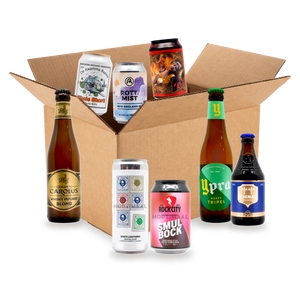
Discovery Box Low Alcohol

16,95
Unit price
per

Only 4 left!

Andere kochten ook

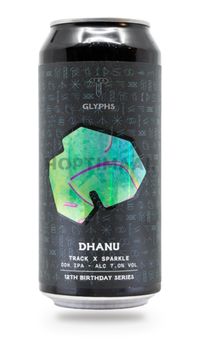
Track Dhanu

10,95

Beer School · Dark & Creamy

Porter

Porter is a dark brown to almost black beer that appeared in London in the early 1720s. The English version tastes of toast, caramel and mild chocolate; the American one is more firmly roasted and more bitter.

  • Alcoholusually 4.0–6.5%; Baltic porter 6.5–9.5%
  • Entry levelFor those who have already tasted a bit

How it usually tastes

Bitter
Sweet
Sour
Roasted
Fruity
Full

Average for this style; every beer has its own accent.

What is it?

Porter has traditionally been top-fermented. A modern English porter is medium-bodied, with a restrained roasted and bitter character. You taste bread, biscuit and toast, mild chocolate and often caramel, nuts or toffee, sometimes a hint of coffee or liquorice. It does not usually taste burnt, and the finish is fairly dry to slightly sweet.

The main variants: - English porter / brown porter: brown, soft and caramel-like, with 4.0–5.4% alcohol (BJCP). - American porter / robust porter: stronger, more bitter and more roasted, sometimes with a slightly burnt edge and clearly hoppy (resin, earth, flowers). - Baltic porter: strong and malty, with dried fruit such as plum and raisin, caramel and liquorice. The alcohol (usually 7–8.5%) is deceptively well hidden. An exception to the rule: this porter is nowadays usually fermented cold with lager yeast and lagered. - Imperial porter: an American, very strong (7–12%) black porter with a full body and notes of cocoa and caramel.

Porter is not a fixed recipe. Through the invention of black malt in 1817, industrial brewing, changes in taste, wars and taxes, the beer changed character again and again over the centuries.

Types of Porter

Myth or fact?

Myth

‘Porter was invented in 1722 by the brewer Ralph Harwood, as a replacement for three threads, a mixture that had to be drawn from three casks.’

This story only appeared in 1802, eighty years after the first porter, and does not hold up. Porter was an improved version of the existing London brown beer.

Myth

‘Porter was invented in 1722 by the brewer Ralph Harwood, as a replacement for three threads, a mixture that had to be drawn from three casks.’

The story comes from John Feltham. It appeared in February 1802 in the Monthly Magazine and in his guide The Picture of London, and was copied endlessly afterwards. According to beer historian Martyn Cornell it is wrong on several points.

First, three threads was, according to dictionaries from 1694–1699 and 1737, a mixture of only two beers: ordinary ale and extra strong beer. That removes the reason for a 'one-cask solution'. Second, in the more than eighty years before 1802 nobody named Harwood as the inventor, except for one brief attempt in 1788. Harwood did exist and brewed porter in Shoreditch, but his brewery was small next to giants such as Truman, Whitbread and Parsons. Third, porter is already mentioned by name in 1721.

What the sources do show: eighteenth-century writers used 'porter' and London 'brown beer' as synonyms. According to Cornell, porter was that existing brown beer, improved under competitive pressure, with more hops and longer maturation. Whether three threads still played a role in this is something historians do not agree on. There is no evidence for Harwood as the inventor.

Sources

True

‘Porter is named after the porters of London.’

Correct: contemporaries already wrote that the beer was so called because porters drank a lot of it. It was mainly about the porters of the Thames quays and the street, not specifically the market porters of Covent Garden.

True

‘Porter is named after the porters of London.’

Eighteenth-century sources are clear on this. The Swiss traveller César de Saussure, who was in London in the 1720s, and the brewery clerk who wrote as 'Obadiah Poundage' (1760) both explain the name from its popularity with porters and other working men. Daniel Defoe described porter in 1724 as a drink of labourers.

It was mainly about the ticket porters and fellowship porters: thousands of men who loaded and unloaded ships on the Thames and carried parcels, letters and goods through the City. Those occupations disappeared in the late 19th century. Once they were forgotten, readers and later writers in the 20th century wrongly began to link the name to the market porters of Covent Garden, Smithfield and Billingsgate.

Other explanations, such as that Harwood had porters deliver the beer or that the name comes from the Dutch word 'poorter', lack any foundation. The BJCP style guide words the porter explanation cautiously, but the evidence from the 18th century is, according to beer historian Martyn Cornell, strong.

Sources

Partly true

‘Porter and stout are two clearly different beer styles.’

Historically, stout was simply stronger porter. Style guides now draw a line (porter brown, stout black), but in practice they largely overlap.

Partly true

‘Porter and stout are two clearly different beer styles.’

In the 18th and 19th centuries 'stout' was the name for a stronger porter; the word meant 'strong'. At Whitbread in London, porter and stouts were brewed from exactly the same raw materials in 1844; in 1805 only the double stout differed slightly in the types of malt. The difference lay in the amount of water, and so in the strength.

In the 20th century the roles reversed: around 1934 porter was called 'a variety of stout', a kind of stout, that is. By now the difference in strength has disappeared too. Some brewers make stouts that are lighter than their porters.

The BJCP style guide describes English porter as brown and Irish stout as black, and that helps with tasting. But beer historian Martyn Cornell found no sharp boundary in strength or flavour in a sample of 30 British porters and stouts.

Sources

Myth

‘The name porter comes from the Dutch word poorter.’

No. 'Poorter' meant citizen and was not a type of beer, and nobody made that connection before the 21st century.

Myth

‘The name porter comes from the Dutch word poorter.’

According to this theory, the London porter of the 1720s goes back to a 14th-century Dutch 'poorterbier'. But 'poorter' was the old Dutch word for citizen. According to beer historian Martyn Cornell, mentions of 'poorter bier' were about the brewing rights of citizens, not about a type of beer.

There are no sources from before the 21st century that connect porter and poorter. There is also no plausible route by which a 14th-century Dutch name would become an 18th-century English beer name.

At the same time, contemporaries in the 18th century wrote, on the contrary, that the name comes from the London porters (see the myth about this).

Sources

Where does it come from?

Porter was not an entirely new beer, but the ordinary London 'brown beer' in improved form: hopped more strongly and matured longer. The oldest known mention by name is in a pamphlet by Nicholas Amhurst of 22 May 1721.

An old brewery clerk who wrote as 'Obadiah Poundage' explained in 1760 that the beer was called 'Porter' or 'Entire Butt' because working men and porters drank it. These were mainly the thousands of porters who loaded and unloaded ships on the Thames and carried goods through London.

Stout began as a stronger porter. In the early 19th century porter became a widely drunk export beer, but by the 1870s it was losing ground. Around the 1950s it disappeared in Great Britain. The American 'robust' porter appeared in 1974, and in 1978 porter returned in the UK.

How to pour it

A good starting point: 10–13 °C in an English pint glass. A Baltic porter can be a bit colder, around 7–10 °C.

Taste it yourself

All Porter in the shop
Did you like this? Then try Bock →

Similar to: Stout, Brown Ale

Also in our beer guide

Terms

Top fermentation (high fermentation)
Fermentation with yeast that rises to the top during fermenting (ale yeast), usually at a higher temperature than bottom fermentation; this is how pale ale, IPA, stout, weizen and Belgian styles such as witbier, dubbel and tripel, among others, are made.
Bottom fermentation (low fermentation)
Fermentation with lager yeast at lower temperatures, in which the yeast sinks to the bottom, as with pilsner and other lagers.
Lagering
Letting beer, especially bottom-fermented beer, mature cold for a time after fermentation, so that yeast and proteins can settle and the flavour improves; the word comes from the German 'lagern', to store.
Malt
Grain, usually barley but for example also wheat, that has been steeped, germinated and dried so that sugars become available for the yeast; the more strongly the malt is roasted, the darker the beer.
Double / imperial
Designation for a stronger and more intense version of a well-known style, such as a double IPA (7.5–10% alcohol according to the BJCP) or an imperial stout (8–12%).
Sources for this page